
Mind Roga
. disease of mind
Dr Dushyant Nirmal
10/14/20251 min read
The Three Universal Qualities
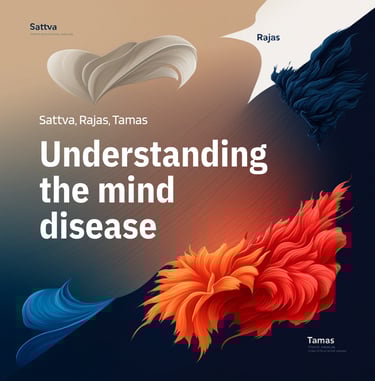
In yoga and Ayurvedic philosophy, everything in the universe is composed of three fundamental energies or qualities, known as gunas:
· Sattva (Balance, Harmony, Light)
· Rajas (Activity, Passion, Movement)
· Tamas (Inertia, Stability, Darkness)
Our minds, bodies, and the world around us are in a constant state of flux as these three gunas interact and dominate one another. While Sattva is the state of clarity and peace, Tamas and Rajas represent the two primary forces of resistance and action that shape much of our experience.
Two mind disease
---
Rajas: The Energy of Action
Rajas is the principle of energy, motion, and change. It is the fuel for all activity.
· Key Qualities: Passion, desire, attachment, restlessness, dynamism, ambition.
· Positive Expression: When balanced, Rajas is the driving force behind achievement, creativity, and the motivation to get things done. It gets us out of bed in the morning and pushes us to pursue our goals.
· Negative Imbalance: When excessive, it leads to anxiety, agitation, greed, and an inability to relax. The mind becomes scattered, constantly seeking external stimulation and validation. You might feel "burned out" or chronically stressed.
· Simple Analogy: A spinning top, a raging fire, a bustling city.
Tamas: The Energy of Inertia
Tamas is the principle of stability, form, and inertia. It provides resistance and structure.
· Key Qualities: Heaviness, darkness, lethargy, ignorance, stability, sleep.
· Positive Expression: In balance, Tamas is essential for rest, sleep, and digestion. It grounds us, provides structure to our bodies and the material world, and allows for the dissolution of old forms to make way for the new.
· Negative Imbalance: When dominant, it manifests as laziness, depression, confusion, attachment, and resistance to change. It creates a sense of heaviness in the body and mind, leading to procrastination and dullness.
· Simple Analogy: A heavy rock, deep sleep, a dense fog.